Monday, December 17, 2012

The Bigger Picture


I've never liked the 50mm lens. I've tried. I even own a few and put one on a camera now and then.

I know, it's the 'standard' lens. So many of the legends have used it to great effect. But I don't like it.

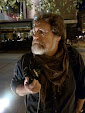
Our natural human vision takes in more, sees a wider angle of view than a 50mm lens allows. I want that wider view in my images. I'm a 28mm shooter because that's the way I see things.

I shoot wide and close. I try to keep my subject in a proper context by shooting this way. It's natural to me. It feels right, it looks right. That's my vision.


Photo: ©2012 David W. Sumner


Saturday, December 8, 2012

Workshops 2013

“Defining Your Vision” January 12th 2013

As a photographer, defining your personal vision is much more than finding a style. Both vision and style take a long time to develop and only find root in the fundamental understanding of what we are actually seeing when we view the world around us.

A long practice of focused, critical seeing is the way to discover what attracts us to a particular scene or image. Only when you understand the attraction can you begin to shape your personal vision.

It is this process of critical seeing that we will begin to explore in this one-day, six-hour workshop, “Defining Your Vision.”

We will begin this exploration by spending some relaxed time viewing photography and painting in the galleries of SFMOMA. You’ll experience a method of seeing that will help you identify the elements (emotions, color, light, line and form) that resonate with you. As we look at the imagery, we will make brief notes, often a single word that describes the essence of the piece, an emotional response to it, an impression of its graphic impact or its use of color.

Next we will meet for a guided discussion of our experiences with the art and our responses to it. With this information, we’ll take to the streets to spend two hours freely shooting images as we make our way from the Financial District to North Beach.
Meeting up in North Beach, we will talk about our experience shooting on the streets: What scenes we were attracted to, how we saw them, what influenced our seeing, and what we observed that was new to our seeing.

What you will learn:
- The difference between looking and seeing that will define your vision.
- Identifying the essential elements necessary to help achieve your vision.
- How to better express your personal vision through a practice of critical seeing.

Schedule:
January 12, 2013
11:00am – Meet in the atrium of SFMOMA (151 3rd Street). Introduction & brief instruction
11:30 – 1:00pm – View art to make notes of impressions or inspirations
1:00 – 2:00pm – Meet on the 5th Floor Roof Top Garden for discussion & brief instruction
2:00 – 4:00pm – Photo walk (individually or in groups)
4:00 – 5:00pm – Meet up at Caffe Greco for discussion & wrap up

What to bring:
A camera – film or digital, SLR or point ‘n shoot
A small notebook or sketchbook
A San Francisco street map
(You may want lunch during the ‘photo walk’ portion of the workshop so be prepared to buy your own lunch along the way or better yet pack a brown bag)

Cost:
$70.00 per person (Includes admission to SFMOMA)
Fees are refundable up to 48 hours prior to the workshop.
(Space is limited to 5 people per workshop)

Registration:
To register for this workshop email your name and address to: dave@bigcrow.com
Your registration will be confirmed once your payment is confirmed. 

Use the Buy Now button below to secure your space in this workshop.

Monday, November 19, 2012

Where Do Projects Come From?


That's never an easy question to answer, regardless of your chosen media or your personal work style.

For me projects usually come about as I start to recognize a body of work developing as I go about shooting day after day. I'll notice something on the street or shoot from a perspective I've not tried before. As I explore this new subject or point of view I may see some sort of story or narrative developing, and that usually happens as I start asking my self the "I wonder" questions.

"I wonder why that woman is in such a hurry?"

"I wonder if other people around here are in a hurry?"

"I wonder what this street corner would look like at lunch time through a 20mm lens?"

"I wonder what kind of images I would get shooting through the window of a moving bus?"

That's actually the project I'm working on now: "Through the Bus Window." In a previous post, "An Old Dog's New Tricks," I talked about exploring the various program settings on my auto focus cameras which I had always thought less than favorably of - the settings not the cameras.

My first experiment was shooting pictures through the window on the bus ride home one afternoon. It was the light of that time of day that inspired me to shoot just then and I happened to be on a bus so there was little else to do but shoot out the window. Once the film was processed and I saw the images I was satisfied that the program settings worked well enough, but I was really excited by the images themselves. 


I started looking for opportunities to shoot pictures through bus windows and I started hearing the "I wonder" questions.
 
"I wonder if I can find a window with just enough grime to shoot through and not lose the image?"

"I wonder where those people on the sidewalk will all end up tonight?"

"I wonder if those people are tourists from Europe or Idaho?"

So, "Through the Bus Window" is starting to take shape and I'm having a blast doing it. I'm also taking pictures in a way that's new to me and there is a lot of chance involved and a lot of not knowing how it's all going to come out, which I find quite refreshing.

Best of all I'm getting those "I wonder" questions, one of which may actually turn me on to my next project.


Photo: ©2012 David W. Sumner

Wednesday, October 17, 2012

Light: The Defining Factor

Robert Adams has said that light is the fundamental element central to our understanding of life and our response to it.

As light is fundamental to photography and our visual interpretation of society, I would go so far to say that as photographers, photography defines our understanding of life and our response to it.


Sunday, October 14, 2012

The Alternative Editor


It's hard to edit your own work. It’s too easy to get stuck on the images you like and mistake those for your best work. That doesn’t mean your favorite images will never be your best work, but selecting your strongest images for a portfolio or a presentation often means letting go of many of those favorites.

A good practice is to have someone else take a crack at editing your images. However, it’s not always easy to find someone who has the time or inclination to help edit your work. This is where joining a Flickr group can be a big help.

If you’re a Flickr user you can join any number of groups that range over a huge variety of interests. Some groups are very serious with very specific criteria that must be met in order to post images to the group’s page, while others may have a single criteria as simple as the type of camera used to make the images being posted.

Some groups are juried. In other words a moderator will select images from all those submitted and decide which pictures will actually be posted to the page. This is in effect a seriously practiced editing process. Over time as more of your work is selected for posting to the group you may find that those are some of your strongest images and a good representation of your over all body of work.

Of course it depends on the group you choose to join as to the results you can expect. But if you join a group that is seriously dedicated to presenting the very best of the type of photography you’re interested in pursuing, chances are you will have chosen a good editor.

I joined such a Flickr group some years ago and since then more of the images I have submitted have been rejected than selected for posting. But I have enough images in the group that I can now step back and take a look at what someone else considers by strongest work. And frankly I’m impressed.

     
I’ve been planning to submit a selection of images to a publisher of post cards, but dreading the selection process. So the other day I went to my Flickr page and went to the group Film is not dead, it just smells funny. On the left side of the window there is a list of the top contributors and at the end of that list is always the word YOU. Click on YOU and all of the your images that have been selected for the group will be displayed with the most recent post first.

Doing this I can see that I have successively contributed 92 images to the group. A quick look tells me two things, first that indeed my strongest images are represented and second that the moderator has a soft spot for pictures of pretty girls. Be that as it may, I now have access a to a well edited selection of my work from which I can now select images to submit to a publisher with a greater level of confidence than if I had tried the entire editing process on my own.

     
To preserve a copy of this record I simply go to File > Print and than select “Save as pdf.” Now I have an easily accessible thumbnail list of all 92 images to refer to when making my selections for the publisher.

I can’t tell you how much time and anxiety this has saved me. It really is very hard to be a ruthless editor of your own work. Fortunately image sharing sites like Flickr provide a variety of editing options that can help you move your work to a new level.


Monday, October 8, 2012

Finding the Image


When you see a scene that appeals to you you make the photograph. But sometimes you look at the print or the image on you screen and it doesn't look like what you remember or you see the scene as you first did but the friends you are showing it to don't see it the same way, they don't see what you were seeing when you made the image.

These are clues that the final image contains more information than it needs to convey the true message of the "Image" as you perceived it.

Take a look at the overall composition and ask yourself, "Where is the image in this? What was I seeing that attracted me to this?"

Often you will find that the real image is only a part of the composition and the solution is getting closer to the real subject of the image or choosing another lens or focal length when photographing, or actually cropping the image in post processing.

Here's how I deal with this situation…when I'm out shooting. Recently while photographing in the Japanese Tea Garden in Golden Gate Park I came up to this statue of a Buddha. I've photographed this statue many times, but I've never been satisfied with the images I've come away with. This day I took more time to work with it and figure out what really attracted me visually to statue.


 I made this frame of the statue and its environment, but I knew this wasn't a defining image.


I moved closer looking through the view finder and the 28mm lens. I stood back and switched to a 55mm lens and made this, the second image. Looking at the statue from this perspective I realized that it was the gesture of the Buddha's hand that attracted me most.

I looked more closely, turning the camera to compose a horizontal frame. Here was my image. I knew now that I had it. I saw the folds of the statue's robe flow into the gesture, guiding the eye to the hand and tips of the fingers. I moved a bit to the left including some of the trees in the background to provide context that wouldn't distract from the graphic power of the overall composition and made the image.

This whole process took much less time than has taken to explain it. The most time consuming part of making the image was the one lens change. Finding the image and making the final frame took only seconds. This is what comes with practice and making photography a practice.


Photos: ©2012 David W. Sumner