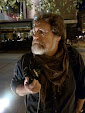
Lens selection is often an interesting topic. I've heard all kinds of suggestions on what's the best lens to use for a particular situation. The on line forums are choked with questions like "What's the best lens to use for portraits?" I find these questions a bit silly. Any "how-to" book or quick web search will tell you the most popular portrait lenses are in the range of 80mm to135mm.
(Kathy Cruver, Nikon F3, 180mm lens ©2002 David W. Sumner)
Really it's not an issue of the best or right lens. What's important is what will work within the context of your shooting style, what are you comfortable with? James Nachtwey has been quoted as saying he never uses anything longer than 50mm. HCB used a 50mm almost exclusively. Josef Koudelka for many years shot almost all his images with wide angle lenses. Then he quit using wide lenses all together. Then later he started using a panoramic camera for much of his work. So what's right?
When I was shooting color landscapes in the 1980's I rarely shot with anything other than my 20mm and 180mm lenses. Today I hardly ever take my 180mm out of the closet. Currently in my bag is a 20mm, 28mm, 55mm, 135mm, and two camera bodies. Now days 95% of my images are made with the 28mm lens. I'm not fond of zoom lenses, I'd rather step closer or move to one side looking for a good perspective. But that's what works for me and I've experimented for many years to get to this point.
 (Artist, Dale Erickson, Nikon F4, 28mm lens ©2006 David W. Sumner)
In reality a nice portrait can be made with a 20mm lens or a 300mm lens. You just have to pay attention to what you're doing. When you're looking through the view finder, look critically. Move a little and keep looking. When it looks good, make the picture. Don't worry about right or wrong. The more you practice the more you become familiar with what makes a good portrait and will realize that a good portrait can be made with any focal length.